

A question has arrived!
I actually have a bit of a backlog of questions — sorry, everyone — but this one is both relevant to the book that just came out (thank you, Irvin, very classy of you to give me a chance to talk up my book), and reasonably quick to answer. As in, I can do it while throwing the ball for Hush, who wants me to throw the ball but isn’t terribly interested in retrieving the ball.1
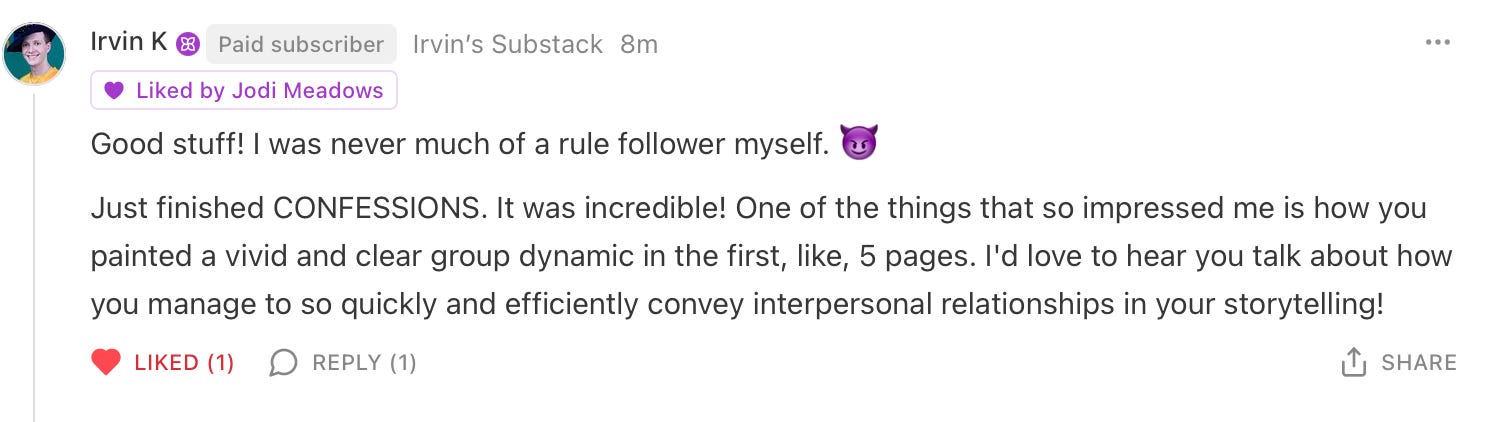
This comment was left on my recent letter, “Bending the rules. Or not.”
This is wonderful to hear! I’m glad it worked for you!
First off: No spoilers. Everything I’m sharing below is either in the first 20 pages or described in the flap copy.
Getting Virginia’s friend group on the page — making their personalities clear and distinct — was something I knew I needed to do immediately, in part because it’s such a short book (50k words, no room to mess around), and also because of what happens pretty soon after you meet them (they have a big falling out).
So I had a few different strategies to get the individual personalities and their group dynamic on the page as fast as possible:
Group project
The four girls are partners in a group project — a review blog on Scrollr — and they all play different roles in that.
This group project is the reader’s introduction to the friend group, so you get to see them performing their different roles right away.
Group projects can be a really vivid illustration of different personalities. Throughout the scene, the reader sees Mary Heather directing everyone and taking notes, Kat being a bit of a firebrand, and Jessica taking photos and having a creative vision for how they’re going to do their thing. Virginia mentions that she does proofreading, and it’s clear she’s not satisfied with her role. (And a bit worried about it.)
You can do this in other settings, too. Maybe it’s a work situation — a team in an office, factory, or kitchen. Oh, heist groups are great examples of characters who have very particular sets of skills.
And group projects are ripe for drama. Maybe multiple people want to be the leader. Or resent the leader. Or feel like their job is the most important job and resent the others for having “easier” jobs.
Group projects are great for quickly introducing characters and showing the pressure those relationships are under.
A character who categorizes
In CONFESSIONS FROM THE GROUP CHAT, Virginia loves to organize things. At this point in the book, we’ve already seen her in the library, happily shelving books into their correct spots.
So when she describes Mary Heather as the queen bee, Jess as the creative genius, and Kat as the rebel, it makes sense with the characterization we’ve already established, and it reenforces what the reader sees on the page from the other three girls.
Obviously, this works best for characters with that personality type, and that’s not going to be every POV character out there. But even if you have a non-POV character who fits this type, you can have that person tell your POV how they view the rest of their group. And maybe your POV thinks that’s interesting, or rude, or disagrees with their assessment — lots of options here! That, too, says something about both characters.
The group dynamics
Because the girls all have distinct personality types — the queen bee, the rebel, the creative, and the Cat Person (that’s Virginia) — I was able to use those to show why they work well together . . . and how drama might present.
If you have a friend group in your story, look for places where their personalities create friction. Try characters on opposite ends of a spectrum. For example, you can see how someone who likes to be organized might struggle with someone who’s less concerned with where things belong! Deadlines schmeadlines.2
But you can also create conflict between characters who’d like to occupy the same space. There’s a bit of a dust-up about this, too, in CONFESSIONS, when Virginia tries learning a bit about photography, and one of the others tells her they already have a photographer and they don’t need two. And because they’re engaged in a group project, it doesn’t make sense to them that Virginia would want to deviate from her role.
And that’s another thing — what if someone is unhappy with their role? What if they want to change? Or they don’t think it fits them?
When you have a really good handle on your characters’ personalities, you can find ways to keep them getting along . . . and plenty of ways to create interesting conflict.
Okay, so you may be asking if all the girls in this book are cookie-cutter archetypes and . . . I mean, I hope not! I don’t think people fit that neatly into boxes! Identifying and demonstrating their personalities was a starting place. You’ll also see the queen bee being silly and the rebel being supportive. They may not have as much page-time as Virginia, the main character, but they also deserve to be shown in 3D.
And that’s the word of caution I’d offer, if you’re looking at the above and thinking about how those tricks might work in your project: People — and characters — are complex. Even antagonists.
So while you’re thinking about your characters’ personalities, think about the ways they go against those typical traits, and, of course, ways their personalities benefit them . . . and hinder them.
Okay! I’m off to find the ball that Hush insisted I throw but refused to return. I have a few more letters in progress, including some responding to the questions that have been waiting (sorry again!), so hopefully those won’t take too much longer to finish.
But if this was helpful to you and you want to see exactly what worked for Irvin, might I suggest giving the book a read?
Every time someone gets a copy of CONFESSIONS, Hush gets the ball thrown for her. And every time someone gets a copy from an independent bookstore, she throws the ball for me!
CONFESSIONS FROM THE GROUP CHAT:
Bookshop.org | Barnes and Noble | AmazonBYE FOREVER, I GUESS:
Bookshop.org | Barnes and Noble | Amazon
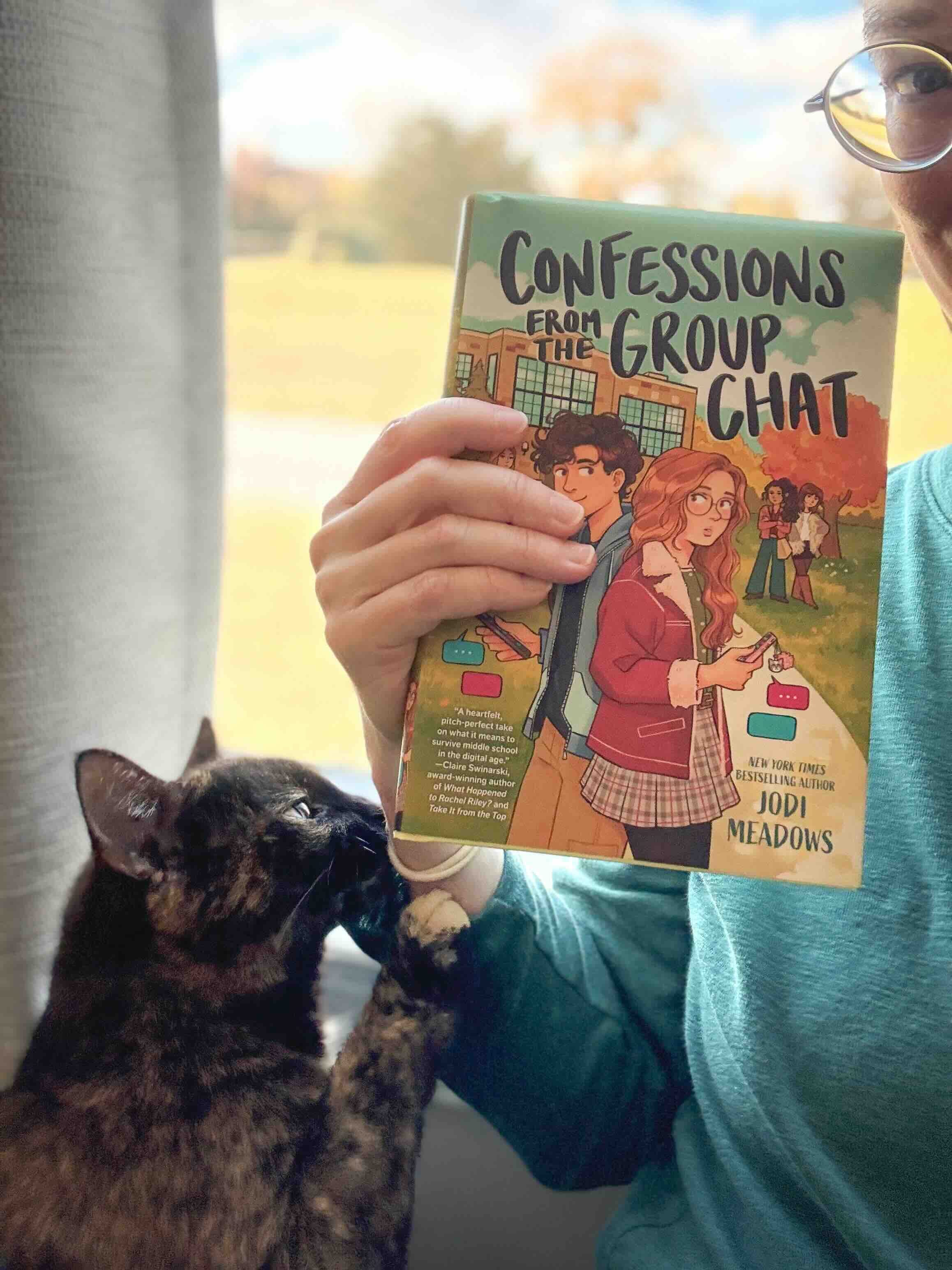
Normally, Hush loves playing fetch. But she really prefers a specific ball, and that ball has been missing for a while. Actually missing, not “missing” so that I can have some peace.
Internal screaming over here. I thrive on a fine balance of space to create and the existential terror of imminent deadlines.
Thanks for answering my question, and in such detail! Definitely going to bookmark this post and return to it often when working on my own stories.